
Controlled finances: AI-powered invoice processing
AILow-codeInvoice processingMendix
Invoice processing is one of the most time-consuming areas of financial administration. Dozens, and in larger organizations, even hundreds of invoices arrive daily through various channels, in different formats and structures. The manual burden is further increased by pairing various financial documents – invoices, purchase orders, certificates of completion. Any incorrect data entry can also entail financial risks (e.g., duplicate payments, late fulfillment).
Our goal was to create an automated system that recognizes and pairs financial documents and extracts key data – significantly reducing processing time.
The starting situation: manual, fragmented process
At many organizations, invoice processing is entirely manual. Besides the volume (up to hundreds of incoming invoices per day), the challenge lies in the variety of documents: handwritten invoices, PDFs generated from various online billing systems, scanned invoices arriving by mail, and differing layouts.
Furthermore, the finance team typically has to manually track down related purchase orders and certificates of completion (CoC) as well.
All of this results in a significant administrative burden, potential for error, and slow processing.
The solution: AI-powered invoice processing workflow
Our solution, built on the Alexis platform, is not just a digital archive but a Mendix low-code-based intelligent assistant that “understands” the content of invoices and their related business documents.
Within the framework of invoice management automation, documents are processed through several AI layers. This consists of three main steps:
1. Document type recognition (classification)
The system determines the type of document:
- invoice
- certificate of completion
- purchase order
This is not tied to a fixed format: the system is trainable and capable of recognizing various structures.
2. Structured data extraction (content understanding)
The system is capable of extracting key data, including:
- invoice number
- performance date
- invoice date
- net/gross amount
- VAT
- seller
- buyer
- tax number
- bank account details
The document content enters the system as structured data. It is important to note that this is not template-based OCR, but AI-based content interpretation capable of handling different formats.
3. Automatic matching
The system not only reads the data but also pairs the related documents (purchase order – CoC – invoice).
Matching occurs based on several parameters, such as amount, date, seller, buyer, and tax number.
The system signals if:
- an invoice has no associated purchase order,
- only a certificate of completion has arrived, but no invoice yet,
- there is a discrepancy in the amounts.
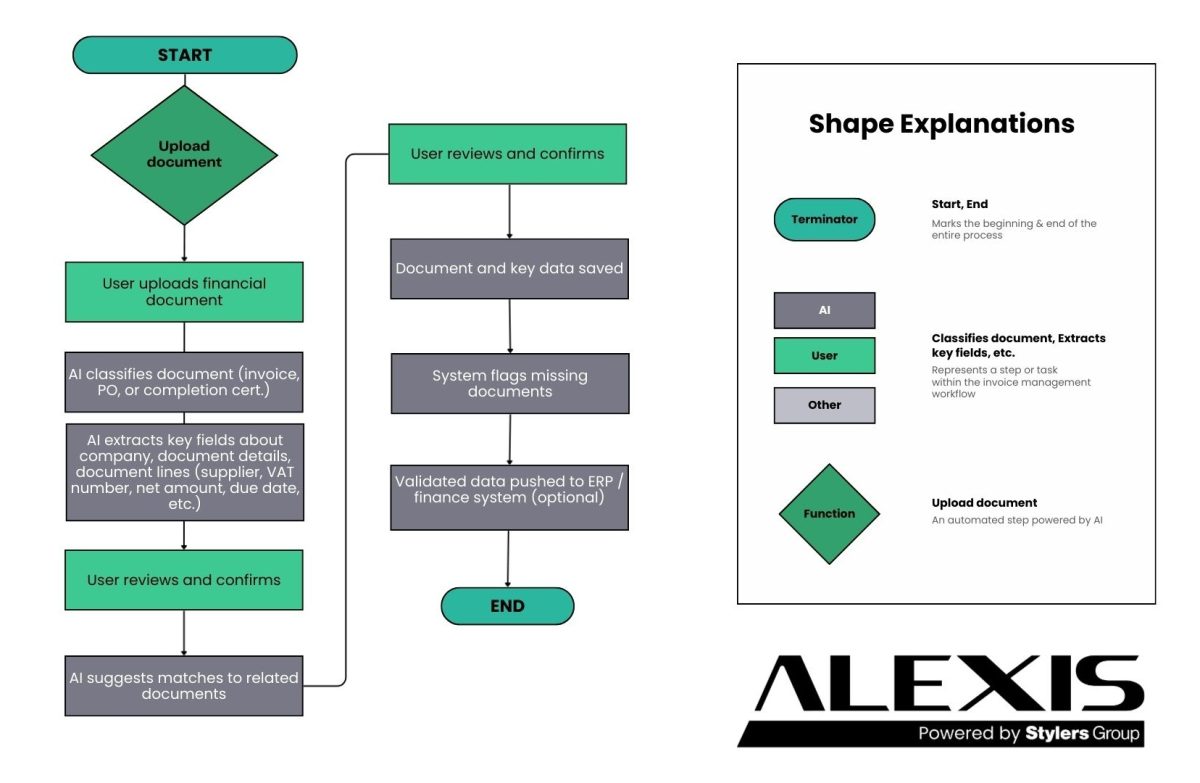
The result:
- 90% less manual entry: The finance team no longer needs to type, but rather verify the data prepared by the AI.
- Secure payments: The possibility of payment “without CoC” is eliminated; every cent is backed by a validated purchase order background.
- Transparency: The automated system greatly facilitates reporting.
- Audit-ready state: During a potential audit, the entire document chain (purchase order + CoC + invoice) can be easily exported from the system.
Integration with existing financial systems
A major advantage of Mendix low-code technology is that it can be easily integrated with the most common systems, allowing processed data to be automatically transferred to the enterprise resource planning system (e.g., SAP, Microsoft Dynamics).
Invoice processing fits into the existing financial workflow and supports further accounting and reporting processes.
What does this mean from a CFO’s perspective?
- Less manual data entry
- Faster invoice processing
- Structured, uniform data
- Decreasing error rate
- Better auditability
- Faster preparation for accounting
- More transparent financial document flow
In the case of 100–150 invoices per day, saving a few minutes per invoice can mean freeing up a full-time employee’s capacity on an annual basis.
AI, of course, does not replace financial control – but it significantly accelerates and makes it more structured.
If you are curious about how you could save a significant portion of your team’s weekly administrative time with automatic invoice processing, we would be happy to present our solution within the framework of a short, personalized consultation.